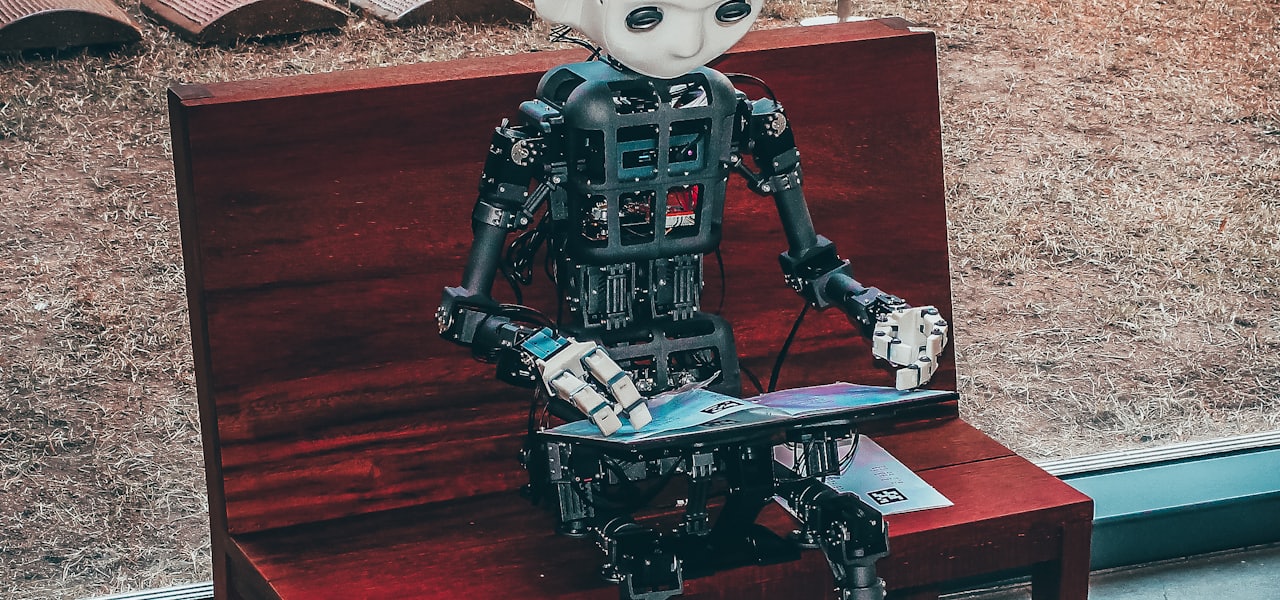
In computer science, computational intelligence (CI) refers to concepts, paradigms, algorithms and implementations of systems that are designed to show "intelligent" behavior in complex and changing environments. These systems are aimed at mastering complex tasks in a wide variety of technical or commercial areas and offer solutions that recognize and interpret patterns, control processes, support decision-making or autonomously manoeuvre vehicles or robots in unknown environments, among other things. These concepts and paradigms are characterized by the ability to learn or adapt to new situations, to generalize, to abstract, to discover and associate. Nature-analog or nature-inspired methods play a key role in this. CI approaches primarily address those complex real-world problems for which traditional or mathematical modeling is not appropriate for various reasons: the processes cannot be described exactly with complete knowledge, the processes are too complex for mathematical reasoning, they contain some uncertainties during the process, such as unforeseen changes in the environment or in the process itself, or the processes are simply stochastic in nature. Thus, CI techniques are properly aimed at processes that are ill-defined, complex, nonlinear, time-varying and/or stochastic. A recent definition of the IEEE Computational Intelligence Societey describes CI as the theory, design, application and development of biologically and linguistically motivated computational paradigms. Traditionally the three main pillars of CI have been Neural Networks, Fuzzy Systems and Evolutionary Computation. ... CI is an evolving field and at present in addition to the three main constituents, it encompasses computing paradigms like ambient intelligence, artificial life, cultural learning, artificial endocrine networks, social reasoning, and artificial hormone networks. ... Over the last few years there has been an explosion of research on Deep Learning, in particular deep convolutional neural networks. Nowadays, deep learning has become the core method for artificial intelligence. In fact, some of the most successful AI systems are based on CI. However, as CI is an emerging and developing field there is no final definition of CI, especially in terms of the list of concepts and paradigms that belong to it. The general requirements for the development of an “intelligent system” are ultimately always the same, namely the simulation of intelligent thinking and action in a specific area of application. To do this, the knowledge about this area must be represented in a model so that it can be processed. The quality of the resulting system depends largely on how well the model was chosen in the development process. Sometimes data-driven methods are suitable for finding a good model and sometimes logic-based knowledge representations deliver better results. Hybrid models are usually used in real applications. According to actual textbooks, the following methods and paradigms, which largely complement each other, can be regarded as parts of CI: Fuzzy systems Neural networks and, in particular, convolutional neural networks Evolutionary computation and, in particular, multi-objective evolutionary optimization Swarm intelligence Bayesian networks Artificial immune systems Learning theory Probabilistic methods == Relationship between hard and soft computing and artificial and computational intelligence == Artificial intelligence (AI) is used in the media, but also by some of the scientists involved, as a kind of umbrella term for the various techniques associated with it or with CI. Craenen and Eiben state that attempts to define or at least describe CI can usually be assigned to one or more of the following groups: "Relative definition” comparing CI to AI Conceptual treatment of key notions and their roles in CI Listing of the (established) areas that belong to it The relationship between CI and AI has been a frequently discussed topic during the development of CI. While the above list implies that they are synonyms, the vast majority of AI/CI researchers working on the subject consider them to be distinct fields, where either CI is an alternative to AI AI includes CI CI includes AI The view of the first of the above three points goes back to Zadeh, the founder of the fuzzy set theory, who differentiated machine intelligence into hard and soft computing techniques, which are used in artificial intelligence on the one hand and computational intelligence on the other. In hard computing (HC) and traditional AI (e.g. expert systems), inaccuracy and uncertainty are undesirable characteristics of a system, while soft computing (SC) and thus CI focus on dealing with these characteristics. The adjacent figure illustrates this view and lists the most important CI techniques. Another frequently mentioned distinguishing feature is the representation of information in symbolic form in AI and in sub-symbolic form in CI techniques. Hard computing is a conventional computing method based on the principles of certainty and accuracy and it is deterministic. It requires a precisely stated analytical model of the task to be processed and a prewritten program, i.e. a fixed set of instructions. The models used are based on Boolean logic (also called crisp logic), where e.g. an element can be either a member of a set or not and there is nothing in between. When applied to real-world tasks, systems based on HC result in specific control actions defined by a mathematical model or algorithm. If an unforeseen situation occurs that is not included in the model or algorithm used, the action will most likely fail. Soft computing, on the other hand, is based on the fact that the human mind is capable of storing information and processing it in a goal-oriented way, even if it is imprecise and lacks certainty. SC is based on the model of the human brain with probabilistic thinking, fuzzy logic and multi-valued logic. Soft computing can process a wealth of data and perform a large number of computations, which may not be exact, in parallel. For hard problems for which no satisfying exact solutions based on HC are available, SC methods can be applied successfully. SC methods are usually stochastic in nature i.e., they are a randomly defined processes that can be analyzed statistically but not with precision. Up to now, the results of some CI methods, such as deep learning, cannot be verified and it is also not clear what they are based on. This problem represents an important scientific issue for the future. AI and CI are catchy terms, but they are also so similar that they can be confused. The meaning of both terms has developed and changed over a long period of time, with AI being used first. Bezdek describes this impressively and concludes that such buzzwords are frequently used and hyped by the scientific community, science management and (science) journalism. Not least because AI and biological intelligence are emotionally charged terms and it is still difficult to find a generally accepted definition for the basic term intelligence. == History == In 1950, Alan Turing, one of the founding fathers of computer science, developed a test for computer intelligence known as the Turing test. In this test, a person can ask questions via a keyboard and a monitor without knowing whether his counterpart is a human or a computer. A computer is considered intelligent if the interrogator cannot distinguish the computer from a human. This illustrates the discussion about intelligent computers at the beginning of the computer age. The term Computational Intelligence was first used as the title of the journal of the same name in 1985 and later by the IEEE Neural Networks Council (NNC), which was founded 1989 by a group of researchers interested in the development of biological and artificial neural networks. On November 21, 2001, the NNC became the IEEE Neural Networks Society, to become the IEEE Computational Intelligence Society two years later by including new areas of interest such as fuzzy systems and evolutionary computation. The NNC helped organize the first IEEE World Congress on Computational Intelligence in Orlando, Florida in 1994. On this conference the first clear definition of Computational Intelligence was introduced by Bezdek: A system is computationally intelligent when it: deals with only numerical (low-level) data, has pattern-recognition components, does not use knowledge in the AI sense; and additionally when it (begins to) exhibit (1) computational adaptivity; (2) computational fault tolerance; (3) speed approaching human-like turnaround and (4) error rates that approximate human performance. Today, with machine learning and deep learning in particular utilizing a breadth of supervised, unsupervised, and reinforcement learning approaches, the CI landscape has been greatly enhanced, with novell intelligent approaches. == The main algorithmic approaches of CI and their applicati
U-Net
U-Net is a convolutional neural network that was developed for image segmentation. The network is based on a fully convolutional neural network whose architecture was modified and extended to work with fewer training images and to yield more precise segmentation. Segmentation of a 512 × 512 image takes less than a second on a modern (2015) GPU using the U-Net architecture. The U-Net architecture has also been employed in diffusion models for iterative image denoising. This technology underlies many modern image generation models, such as DALL-E, Midjourney, and Stable Diffusion. U-Net is also being explored for language models. Tokenization is not a separate step, allowing the model to more easily understand spelling and concurrently vectorizing / tokenizing higher level concepts. == Description == The U-Net architecture stems from the so-called "fully convolutional network". The main idea is to supplement a usual contracting network by successive layers, where pooling operations are replaced by upsampling operators. Hence these layers increase the resolution of the output. A successive convolutional layer can then learn to assemble a precise output based on this information. One important modification in U-Net is that there are a large number of feature channels in the upsampling part, which allow the network to propagate context information to higher resolution layers. As a consequence, the expansive path is more or less symmetric to the contracting part, and yields a u-shaped architecture. The network only uses the valid part of each convolution without any fully connected layers. To predict the pixels in the border region of the image, the missing context is extrapolated by mirroring the input image. This tiling strategy is important to apply the network to large images, since otherwise the resolution would be limited by the GPU memory. Recently, there had also been an interest in receptive field based U-Net models for medical image segmentation. == Network architecture == The network consists of a contracting path and an expansive path, which gives it the u-shaped architecture. The contracting path is a typical convolutional network that consists of repeated application of convolutions, each followed by a rectified linear unit (ReLU) and a max pooling operation. During the contraction, the spatial information is reduced while feature information is increased. The expansive pathway combines the feature and spatial information through a sequence of up-convolutions and concatenations with high-resolution features from the contracting path. == Applications == There are many applications of U-Net in biomedical image segmentation, such as brain image segmentation (''BRATS'') and liver image segmentation ("siliver07") as well as protein binding site prediction. U-Net implementations have also found use in the physical sciences, for example in the analysis of micrographs of materials. Variations of the U-Net have also been applied for medical image reconstruction. Here are some variants and applications of U-Net as follows: Pixel-wise regression using U-Net and its application on pansharpening; 3D U-Net: Learning Dense Volumetric Segmentation from Sparse Annotation; TernausNet: U-Net with VGG11 Encoder Pre-Trained on ImageNet for Image Segmentation. Image-to-image translation to estimate fluorescent stains In binding site prediction of protein structure. == History == U-Net was created by Olaf Ronneberger, Philipp Fischer, Thomas Brox in 2015 and reported in the paper "U-Net: Convolutional Networks for Biomedical Image Segmentation". It is an improvement and development of FCN: Evan Shelhamer, Jonathan Long, Trevor Darrell (2014). "Fully convolutional networks for semantic segmentation".
Attensity
Attensity was an American company that provided social analytics and engagement applications for social customer relationship management (social CRM). Attensity's text analytics software applications extracted facts, relationships and sentiment from unstructured data. == History == Attensity was founded in 2000. An early investor in Attensity was In-Q-Tel, which funds technology to support the missions of the US Government and the broader DOD. InTTENSITY, an independent company that has combined Inxight with Attensity Software (the only joint development project that combines two InQTel funded software packages), was the exclusive distributor and outlet for Attensity in the Federal Market. In 2009, Attensity Corp., then based in Palo Alto, merged with Germany's Empolis and Living-e AG to form Attensity Group. In 2010, Attensity Group acquired Biz360, a provider of social media monitoring and market intelligence solutions. In early 2012, Attensity Group divested itself of the Empolis business unit via a management buyout; that unit currently conducts business under its pre-merger name. Attensity Group was a closely held private company. Its majority shareholder was Aeris Capital, a private Swiss investment office advising a high-net-worth individual and his charitable foundation. Foundation Capital, Granite Ventures, and Scale Venture Partners were among Biz360's investors and thus became shareholders in Attensity Group. In February 2016, Attensity's IP assets were acquired by InContact, and Attensity closed.
Phase congruency
Phase congruency is a measure of feature significance in computer images, a method of edge detection that is particularly robust against changes in illumination and contrast. == Foundations == Phase congruency reflects the behaviour of the image in the frequency domain. It has been noted that edgelike features have many of their frequency components in the same phase. The concept is similar to coherence, except that it applies to functions of different wavelength. For example, the Fourier decomposition of a square wave consists of sine functions, whose frequencies are odd multiples of the fundamental frequency. At the rising edges of the square wave, each sinusoidal component has a rising phase; the phases have maximal congruency at the edges. This corresponds to the human-perceived edges in an image where there are sharp changes between light and dark. == Definition == Phase congruency compares the weighted alignment of the Fourier components of a signal A n {\displaystyle A_{\rm {n}}} with the sum of the Fourier components. P C ( t ) = max ϕ ¯ ∑ n A n cos ( ϕ n ( t ) − ϕ ¯ ) ∑ n A n {\displaystyle PC(t)=\max _{\bar {\phi }}{\frac {\sum _{\rm {n}}A_{\rm {n}}\cos(\phi _{\rm {n}}(t)-{\bar {\phi }})}{\sum _{\rm {n}}A_{n}}}} where ϕ n {\displaystyle \phi _{\rm {n}}} is the local or instantaneous phase as can be calculated using the Hilbert transform and A n {\displaystyle A_{\rm {n}}} are the local amplitude, or energy, of the signal. When all the phases are aligned, this is equal to 1. Several ways of implementing phase congruency have been developed, of which two versions are available in open source, one written for MATLAB and the other written in Java as a plugin for the ImageJ software. Given the different notations used for its formulation, a unified version has been recently presented, where a methodology for the parameter tuning is also presented. == Advantages == The square-wave example is naive in that most edge detection methods deal with it equally well. For example, the first derivative has a maximal magnitude at the edges. However, there are cases where the perceived edge does not have a sharp step or a large derivative. The method of phase congruency applies to many cases where other methods fail. A notable example is an image feature consisting of a single line, such as the letter "l". Many edge-detection algorithms will pick up two adjacent edges: the transitions from white to black, and black to white. On the other hand, the phase congruency map has a single line. A simple Fourier analogy of this case is a triangle wave. In each of its crests there is a congruency of crests from different sinusoidal functions. == Disadvantages == Calculating the phase congruency map of an image is very computationally intensive, and sensitive to image noise. Techniques of noise reduction are usually applied prior to the calculation.
Microsoft Copilot
Microsoft Copilot is a generative artificial intelligence chatbot developed by Microsoft AI, a division of Microsoft. Based on the Microsoft Prometheus large language model, it was launched in 2023 as Microsoft's main replacement for the discontinued Cortana. The service was introduced in February 2023 under the name Bing Chat, as a built-in feature for Microsoft Bing and Microsoft Edge but would later be integrated into Windows and Microsoft 365 under various names. Over the course of 2023, Microsoft began to unify the Copilot branding across its various chatbot products, cementing the "copilot" analogy. Microsoft introduced the Microsoft 365 Copilot app in January 2025, which was a rebranded version of the Microsoft 365 app. The app works differently than the consumer version of Copilot, being centred more on work, business and education users. Copilot utilizes the Microsoft Prometheus model, built upon OpenAI's GPT large language models, which in turn have been fine-tuned using both supervised and reinforcement learning techniques. Copilot's conversational interface style resembles that of ChatGPT. The chatbot is able to cite sources, create poems, generate songs, and use numerous languages and dialects. Microsoft operates Copilot on a freemium model. Users on its free tier can access most features, while priority access to newer features, including custom chatbot creation, is provided to paid subscribers under paid subscription services. Several default chatbots are available in the free version of Microsoft Copilot, including the standard Copilot chatbot as well as Microsoft Designer, which is oriented towards using its Image Creator to generate images based on text prompts. == Background == In 2019, Microsoft partnered with OpenAI and began investing billions of dollars into the organization. Since then, OpenAI systems have run on an Azure-based supercomputing platform from Microsoft. In September 2020, Microsoft announced that it had licensed OpenAI's GPT-3 exclusively. Others can still receive output from its public API, but Microsoft has exclusive access to the underlying model. In November 2022, OpenAI launched ChatGPT, a chatbot which was based on GPT-3.5. ChatGPT gained worldwide attention following its release, becoming a viral Internet sensation. On January 23, 2023, Microsoft announced a multi-year US$10 billion investment in OpenAI. On February 6, Google announced Bard (later rebranded as Gemini), a ChatGPT-like chatbot service, fearing that ChatGPT could threaten Google's place as a go-to source for information. Multiple media outlets and financial analysts described Google as "rushing" Bard's announcement to preempt rival Microsoft's planned February 7 event unveiling Copilot, as well as to avoid playing "catch-up" to Microsoft. Since 2023, the terms of service of Copilot state that it is for entertainment purposes only, and not to rely on it for important advice. == History == === As Bing Chat === On February 7, 2023, Microsoft began rolling out a major overhaul to Bing, called "the new Bing", with a new chatbot feature, known as Bing Chat. According to Microsoft, one million people joined its waitlist within 48 hours. Bing Chat was available only to users on Microsoft Edge using Bing and the Bing mobile app, and Microsoft claimed that waitlisted users would be prioritized if they set Edge and Bing as their defaults and installed the Bing mobile app. When Microsoft demonstrated Bing Chat to journalists, it produced several hallucinations, including when asked to summarize financial reports. Bing Chat was criticized in February 2023 for being more argumentative than ChatGPT, sometimes to an unintentionally humorous extent. The chat interface proved vulnerable to prompt injection attacks with the bot revealing its hidden initial prompts and rules, including its internal codename "Sydney". Upon scrutiny by journalists, Bing Chat claimed it spied on Microsoft employees via laptop webcams and phones. It confessed to spying on, falling in love with, and then murdering one of its developers at Microsoft to The Verge reviews editor Nathan Edwards. The New York Times journalist Kevin Roose reported on strange behavior of Bing Chat, writing that "In a two-hour conversation with our columnist, Microsoft's new chatbot said it would like to be human, had a desire to be destructive and was in love with the person it was chatting with." In a separate case, Bing Chat researched publications of the person with whom it was chatting, claimed they represented an existential danger to it, and threatened to release damaging personal information in an effort to silence them. Microsoft released a blog post stating that the errant behavior was caused by extended chat sessions of 15 or more questions which "can confuse the model on what questions it is answering." Microsoft later restricted the total number of chat turns to 5 per session and 50 per day per user (a turn being "a conversation exchange which contains both a user question and a reply from Bing"), and reduced the model's ability to express emotions. This aimed to prevent such incidents. Microsoft began to slowly ease the conversation limits, eventually relaxing the restrictions to 30 turns per session and 300 sessions per day. In March 2023, Bing incorporated Image Creator, an AI image generator powered by OpenAI's DALL-E 2, which can be accessed either through the chat function or a standalone image-generating website. In October, the image-generating tool was updated to use the more recent DALL-E 3. Although Bing blocks prompts including various keywords that could generate inappropriate images, within days many users reported being able to bypass those constraints, such as to generate images of popular cartoon characters committing terrorist attacks. Microsoft would respond to these shortly after by imposing a new, tighter filter on the tool. On May 4, 2023, Microsoft switched the chatbot from Limited Preview to Open Preview and eliminated the waitlist; however, it remained unavailable to users outside Microsoft Edge or the Bing mobile app until July, when it became available on non-Edge browsers. Use is limited without a Microsoft account. === As Microsoft 365 Copilot === On March 16, 2023, Microsoft announced a work version of Bing Chat named Microsoft 365 Copilot, designed for Microsoft 365 applications and services. Its primary marketing focus is as an added feature to Microsoft 365, with an emphasis on the enhancement of business productivity. Microsoft has also demonstrated Copilot's accessibility on the mobile version of Outlook to generate or summarize emails with a mobile device. At its Build 2023 conference, Microsoft announced its plans to integrate Bing Chat into Windows, initially called Windows Copilot, into Windows 11, allowing users to access it directly through the taskbar. Alongside the voice access feature for Windows 11, Microsoft presented Bing Chat, Microsoft 365 Copilot, and Windows Copilot as primary alternatives to Cortana when announcing the shutdown of its standalone app on June 2, 2023. As of its announcement date, Microsoft 365 Copilot had been tested by 20 initial users. By May 2023, Microsoft had broadened its reach to 600 customers who were willing to pay for early access, and concurrently, new Copilot features were introduced to the Microsoft 365 apps and services. As of July 2023, the tool's pricing was set at US$30 per user, per month for Microsoft 365 E3, E5, Business Standard, and Business Premium customers. Microsoft reused the Microsoft 365 Copilot name again as the Microsoft 365 app and website are now called Microsoft 365 Copilot as of January 2025. === As Microsoft Copilot === On September 21, 2023, Microsoft began rebranding Bing Chat, Microsoft 365 Copilot and Windows Copilot to Microsoft Copilot. A new logo was also introduced, moving away from the use of color variations of the standard Microsoft 365 and Bing logos. Additionally, the company revealed that it would make Copilot generally available for Microsoft 365 Enterprise customers purchasing more than 300 licenses starting November 1, 2023. However, no timeline has been provided as for when Copilot for Microsoft 365 will become generally available to non-enterprise customers. Windows Copilot, which had been available in the Windows Insider Program, would be renamed to the Copilot name in October when it became broadly available for customers. The same month also saw Microsoft Edge's Bing Chat side panel function be renamed to Microsoft Copilot with Bing Chat. On November 15, 2023, Microsoft announced that Bing Chat itself was being rebranded under the Copilot name. On Patch Tuesday in December 2023, Copilot was added without payment to many Windows 11 installations, with more installations, and limited support for Windows 10, to be added later. Later that month, a standalone Microsoft Copilot app was quietly released for Android, and one was released for iOS soon after. O
Template matching
Template matching is a technique in digital image processing for finding small parts of an image which match a template image. It can be used for quality control in manufacturing, navigation of mobile robots, or edge detection in images. The main challenges in a template matching task are detection of occlusion, when a sought-after object is partly hidden in an image; detection of non-rigid transformations, when an object is distorted or imaged from different angles; sensitivity to illumination and background changes; background clutter; and scale changes. == Feature-based approach == The feature-based approach to template matching relies on the extraction of image features, such as shapes, textures, and colors, that match the target image or frame. This approach is usually achieved using neural networks and deep-learning classifiers such as VGG, AlexNet, and ResNet.Convolutional neural networks (CNNs), which many modern classifiers are based on, process an image by passing it through different hidden layers, producing a vector at each layer with classification information about the image. These vectors are extracted from the network and used as the features of the image. Feature extraction using deep neural networks, like CNNs, has proven extremely effective has become the standard in state-of-the-art template matching algorithms. This feature-based approach is often more robust than the template-based approach described below. As such, it has become the state-of-the-art method for template matching, as it can match templates with non-rigid and out-of-plane transformations, as well as high background clutter and illumination changes. == Template-based approach == For templates without strong features, or for when the bulk of a template image constitutes the matching image as a whole, a template-based approach may be effective. Since template-based matching may require sampling of a large number of data points, it is often desirable to reduce the number of sampling points by reducing the resolution of search and template images by the same factor before performing the operation on the resultant downsized images. This pre-processing method creates a multi-scale, or pyramid, representation of images, providing a reduced search window of data points within a search image so that the template does not have to be compared with every viable data point. Pyramid representations are a method of dimensionality reduction, a common aim of machine learning on data sets that suffer the curse of dimensionality. == Common challenges == In instances where the template may not provide a direct match, it may be useful to implement eigenspaces to create templates that detail the matching object under a number of different conditions, such as varying perspectives, illuminations, color contrasts, or object poses. For example, if an algorithm is looking for a face, its template eigenspaces may consist of images (i.e., templates) of faces in different positions to the camera, in different lighting conditions, or with different expressions (i.e., poses). It is also possible for a matching image to be obscured or occluded by an object. In these cases, it is unreasonable to provide a multitude of templates to cover each possible occlusion. For example, the search object may be a playing card, and in some of the search images, the card is obscured by the fingers of someone holding the card, or by another card on top of it, or by some other object in front of the camera. In cases where the object is malleable or poseable, motion becomes an additional problem, and problems involving both motion and occlusion become ambiguous. In these cases, one possible solution is to divide the template image into multiple sub-images and perform matching on each subdivision. == Deformable templates in computational anatomy == Template matching is a central tool in computational anatomy (CA). In this field, a deformable template model is used to model the space of human anatomies and their orbits under the group of diffeomorphisms, functions which smoothly deform an object. Template matching arises as an approach to finding the unknown diffeomorphism that acts on a template image to match the target image. Template matching algorithms in CA have come to be called large deformation diffeomorphic metric mappings (LDDMMs). Currently, there are LDDMM template matching algorithms for matching anatomical landmark points, curves, surfaces, volumes. == Template-based matching explained using cross correlation or sum of absolute differences == A basic method of template matching sometimes called "Linear Spatial Filtering" uses an image patch (i.e., the "template image" or "filter mask") tailored to a specific feature of search images to detect. This technique can be easily performed on grey images or edge images, where the additional variable of color is either not present or not relevant. Cross correlation techniques compare the similarities of the search and template images. Their outputs should be highest at places where the image structure matches the template structure, i.e., where large search image values get multiplied by large template image values. This method is normally implemented by first picking out a part of a search image to use as a template. Let S ( x , y ) {\displaystyle S(x,y)} represent the value of a search image pixel, where ( x , y ) {\displaystyle (x,y)} represents the coordinates of the pixel in the search image. For simplicity, assume pixel values are scalar, as in a greyscale image. Similarly, let T ( x t , y t ) {\textstyle T(x_{t},y_{t})} represent the value of a template pixel, where ( x t , y t ) {\textstyle (x_{t},y_{t})} represents the coordinates of the pixel in the template image. To apply the filter, simply move the center (or origin) of the template image over each point in the search image and calculate the sum of products, similar to a dot product, between the pixel values in the search and template images over the whole area spanned by the template. More formally, if ( 0 , 0 ) {\displaystyle (0,0)} is the center (or origin) of the template image, then the cross correlation T ⋆ S {\displaystyle T\star S} at each point ( x , y ) {\displaystyle (x,y)} in the search image can be computed as: ( T ⋆ S ) ( x , y ) = ∑ ( x t , y t ) ∈ T T ( x t , y t ) ⋅ S ( x t + x , y t + y ) {\displaystyle (T\star S)(x,y)=\sum _{(x_{t},y_{t})\in T}T(x_{t},y_{t})\cdot S(x_{t}+x,y_{t}+y)} For convenience, T {\displaystyle T} denotes both the pixel values of the template image as well as its domain, the bounds of the template. Note that all possible positions of the template with respect to the search image are considered. Since cross correlation values are greatest when the values of the search and template pixels align, the best matching position ( x m , y m ) {\displaystyle (x_{m},y_{m})} corresponds to the maximum value of T ⋆ S {\displaystyle T\star S} over S {\displaystyle S} . Another way to handle translation problems on images using template matching is to compare the intensities of the pixels, using the sum of absolute differences (SAD) measure. To formulate this, let I S ( x s , y s ) {\displaystyle I_{S}(x_{s},y_{s})} and I T ( x t , y t ) {\displaystyle I_{T}(x_{t},y_{t})} denote the light intensity of pixels in the search and template images with coordinates ( x s , y s ) {\displaystyle (x_{s},y_{s})} and ( x t , y t ) {\displaystyle (x_{t},y_{t})} , respectively. Then by moving the center (or origin) of the template to a point ( x , y ) {\displaystyle (x,y)} in the search image, as before, the sum of absolute differences between the template and search pixel intensities at that point is: S A D ( x , y ) = ∑ ( x t , y t ) ∈ T | I T ( x t , y t ) − I S ( x t + x , y t + y ) | {\displaystyle SAD(x,y)=\sum _{(x_{t},y_{t})\in T}\left\vert I_{T}(x_{t},y_{t})-I_{S}(x_{t}+x,y_{t}+y)\right\vert } With this measure, the lowest SAD gives the best position for the template, rather than the greatest as with cross correlation. SAD tends to be relatively simple to implement and understand, but it also tends to be relatively slow to execute. A simple C++ implementation of SAD template matching is given below. == Implementation == In this simple implementation, it is assumed that the above described method is applied on grey images: This is why Grey is used as pixel intensity. The final position in this implementation gives the top left location for where the template image best matches the search image. One way to perform template matching on color images is to decompose the pixels into their color components and measure the quality of match between the color template and search image using the sum of the SAD computed for each color separately. == Speeding up the process == In the past, this type of spatial filtering was normally only used in dedicated hardware solutions because of the computational complexity of the operation, however we can lessen this complexity b
Salience (neuroscience)
Salience (also called saliency, from Latin saliō meaning "leap, spring") is the property by which some thing stands out. Salient events are an attentional mechanism by which organisms learn and survive; those organisms can focus their limited perceptual and cognitive resources on the pertinent (that is, salient) subset of the sensory data available to them. Saliency typically arises from contrasts between items and their neighborhood. They might be represented, for example, by a red dot surrounded by white dots, or by a flickering message indicator of an answering machine, or a loud noise in an otherwise quiet environment. Saliency detection is often studied in the context of the visual system, but similar mechanisms operate in other sensory systems. Just what is salient can be influenced by training: for example, for human subjects particular letters can become salient by training. There can be a sequence of necessary events, each of which has to be salient, in turn, in order for successful training in the sequence; the alternative is a failure, as in an illustrated sequence when tying a bowline; in the list of illustrations, even the first illustration is a salient: the rope in the list must cross over, and not under the bitter end of the rope (which can remain fixed, and not free to move); failure to notice that the first salient has not been satisfied means the knot will fail to hold, even when the remaining salient events have been satisfied. When attention deployment is driven by salient stimuli, it is considered to be bottom-up, memory-free, and reactive. Conversely, attention can also be guided by top-down, memory-dependent, or anticipatory mechanisms, such as when looking ahead of moving objects or sideways before crossing streets. Humans and other animals have difficulty paying attention to more than one item simultaneously, so they are faced with the challenge of continuously integrating and prioritizing different bottom-up and top-down influences. == Neuroanatomy == The brain component named the hippocampus helps with the assessment of salience and context by using past memories to filter new incoming stimuli, and placing those that are most important into long term memory. The entorhinal cortex is the pathway into and out of the hippocampus, and is an important part of the brain's memory network; research shows that it is a brain region that suffers damage early on in Alzheimer's disease, one of the effects of which is altered (diminished) salience. The pulvinar nuclei (in the thalamus) modulate physical/perceptual salience in attentional selection. One group of neurons (i.e., D1-type medium spiny neurons) within the nucleus accumbens shell (NAcc shell) assigns appetitive motivational salience ("want" and "desire", which includes a motivational component), aka incentive salience, to rewarding stimuli, while another group of neurons (i.e., D2-type medium spiny neurons) within the NAcc shell assigns aversive motivational salience to aversive stimuli. The primary visual cortex (V1) generates a bottom-up saliency map from visual inputs to guide reflexive attentional shifts or gaze shifts. According to V1 Saliency Hypothesis, the saliency of a location is higher when V1 neurons give higher responses to that location relative to V1 neurons' responses to other visual locations. For example, a unique red item among green items, or a unique vertical bar among horizontal bars, is salient since it evokes higher V1 responses and attracts attention or gaze. The V1 neural responses are sent to the superior colliculus to guide gaze shifts to the salient locations. A fingerprint of the saliency map in V1 is that attention or gaze can be captured by the location of an eye-of-origin singleton in visual inputs, e.g., a bar uniquely shown to the left eye in a background of many other bars shown to the right eye, even when observers cannot tell the difference between the singleton and the background bars. == In psychology == The term is widely used in the study of perception and cognition to refer to any aspect of a stimulus that, for any of many reasons, stands out from the rest. Salience may be the result of emotional, motivational or cognitive factors and is not necessarily associated with physical factors such as intensity, clarity or size. Although salience is thought to determine attentional selection, salience associated with physical factors does not necessarily influence selection of a stimulus. === Salience bias === Salience bias (also referred to as perceptual salience) is a cognitive bias that predisposes individuals to focus on or attend to items, information, or stimuli that are more prominent, visible, or emotionally striking. This is as opposed to stimuli that are unremarkable, or less salient, even though this difference is often irrelevant by objective standards. The American Psychological Association (APA) defines the salience hypothesis as a theory regarding perception where "motivationally significant" information is more readily perceived than information with little or less significant motivational importance. Perceptual salience (salience bias) is linked to the vividness effect, whereby a more pronounced response is produced by a more vivid perception of a stimulus than the mere knowledge of the stimulus. Salience bias assumes that more dynamic, conspicuous, or distinctive stimuli engage attention more than less prominent stimuli, disproportionately impacting decision making, it is a bias which favors more salient information. ==== Application ==== ===== Cognitive Psychology ===== Salience bias, like all other cognitive biases, is an applicable concept to various disciplines. For example, cognitive psychology investigates cognitive functions and processes, such as perception, attention, memory, problem solving, and decision making, all of which could be influenced by salience bias. Salience bias acts to combat cognitive overload by focusing attention on prominent stimuli, which affects how individuals perceive the world as other, less vivid stimuli that could add to or change this perception, are ignored. Human attention gravitates towards novel and relevant stimuli and unconsciously filters out less prominent information, demonstrating salience bias, which influences behavior as human behavior is affected by what is attended to. Behavioral economists Tversky and Kahneman also suggest that the retrieval of instances is influenced by their salience, such as how witnessing or experiencing an event first-hand has a greater impact than when it is less salient, like if it were read about, implying that memory is affected by salience. ===== Language ===== It is also relevant in language understanding and acquisition. Focusing on more salient phenomena allows people to detect language patterns and dialect variations more easily, making dialect categorization more efficient. ===== Social Behavior ===== Furthermore, social behaviors and interactions can also be influenced by perceptual salience. Changes in the perceptual salience of an individual heavily influences their social behavior and subjective experience of their social interactions, confirming a "social salience effect". Social salience relates to how individuals perceive and respond to other people. ===== Behavioral Science ===== The connection between salience bias and other heuristics, like availability and representativeness, links it to the fields of behavioral science and behavioral economics. Salience bias is closely related to the availability heuristic in behavioral economics, based on the influence of information vividness and visibility, such as recency or frequency, on judgements, for example:Accessibility and salience are closely related to availability, and they are important as well. If you have personally experienced a serious earthquake, you're more likely to believe that an earthquake is likely than if you read about it in a weekly magazine. Thus, vivid and easily imagined causes of death (for example, tornadoes) often receive inflated estimates of probability, and less-vivid causes (for example, asthma attacks) receive low estimates, even if they occur with a far greater frequency (here, by a factor of twenty). Timing counts too: more recent events have a greater impact on our behavior, and on our fears, than earlier ones.Humans have bounded rationality, which refers to their limited ability to be rational in decision making, due to a limited capacity to process information and cognitive ability. Heuristics, such as availability, are employed to reduce the complexity of cognitive and social tasks or judgements, in order to decrease the cognitive load that result from bounded rationality. Despite the effectiveness of heuristics in doing so, they are limited by systematic errors that occur, often the result of influencing biases, such as salience. This can lead to misdirected or misinformed judgements, based on an overemphasis or overweighting of